


A Very Demanding Machine

The Garage Sale
She found it on a Saturday, the way these things are always found.
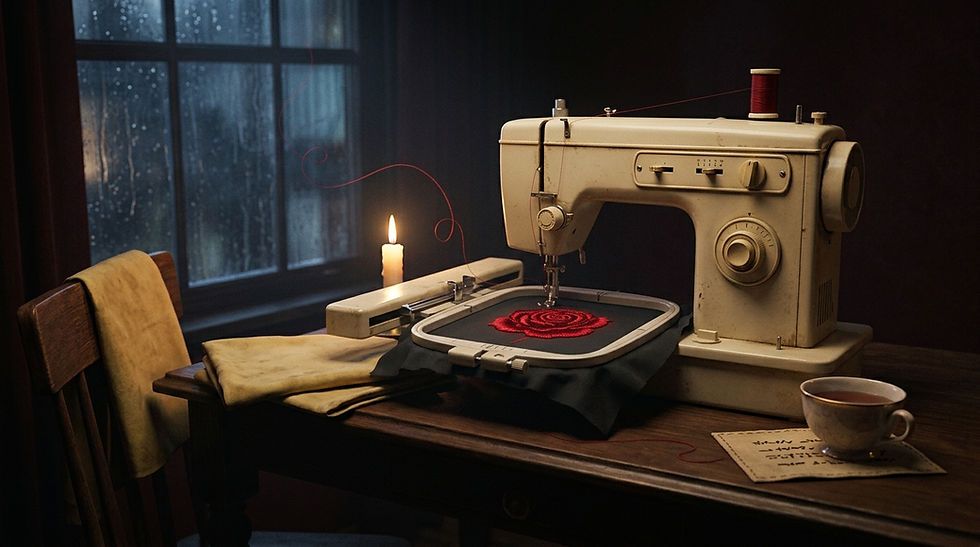
It sat on a folding table between a box of mismatched teacups and a lamp with no shade. The machine was cream-colored and heavy, with a dust cover yellowed like old piano keys. A strip of masking tape on the lid read $40, written in a shaky hand.
The seller was a thin, grey woman who did not look at her once. She only watched the machine, the way you watch a dog you are not sure about. Her hands trembled in the sleeves of her cardigan, and when she reached for the money, the sleeve pulled back, exposing the tiny maps of pale scars that wrapped around her fingertips.
“Does it work?” she asked.
“It works,” the seller said. “It works very well.”
Then the woman took the forty dollars, folded it small, and put it in her pocket without counting it.
She should have asked why.
Year One: The Perfect Stitch
At first, it was a miracle.
She set it up on the oak table by the window and threaded it, and it stitched the first design out like a held breath finally let go. No puckering. No birdnesting. No tension drifting at stitch four thousand. Every satin column lay down like wet ink, and every jump thread was trimmed before she thought to look for it.
She had stitched for years, and she knew what a machine is supposed to do. This one did not behave like a machine. It behaved like something that had done this ten thousand times and had nothing left to prove.
The bobbin never ran out at the wrong moment. The thread never snapped. When she loaded a long design, the machine finished on the last stitch, with the last color change landing exactly as she reached for her tea.
She told no one. People ask questions about luck like that.
Then, in the autumn, the first word appeared.
She had finished a small monogram and lifted the hoop to trim it. Beneath the letter, in the same dark thread, was a single line of tiny backstitched script that she had not digitized and had not loaded.
Stay.
She laughed, because what else could she do? A glitch, she told herself. A corrupted file. She deleted the design, ran a virus check on a machine that was not connected to anything, and stitched the monogram again.
It came out perfect. There was no word beneath it.
She almost forgot about it by spring.
Year Two: What It Wanted
The messages came more often after that, and they were not always unkind.
Some mornings the hoop held a line of small, neat encouragement. Well done. Or Again, but slower. Once, after a bad week, it stitched You are not behind across the corner of a test square, and she sat at the table and cried for twenty minutes without knowing exactly why.
But the machine did not only give. It asked.
Thread me red.
She had only a spool of dark crimson, which she had been saving for something worthwhile. She threaded it, and the machine ran it beautifully, and the hoop came out holding a rose so lifelike she could almost smell it.
The next week the message was longer.
Not the spool. The other red.
She stared at it for a long time. Then she looked down at her left hand, where a needle had caught her fingertip an hour earlier while she was changing a needle plate. A single bright bead of blood had welled up and fallen near the needle.
The machine had already stitched around it.
She told herself that was an accident, the same way she told herself everything.
But after that, whenever she bled, the work was a little better. The stitches were a little finer, and the designs looked like they had been drawn by something that had seen the real thing. When she kept her hands careful, the machine did not punish her. It simply waited, and the hoop came out merely perfect rather than alive.
She began to notice the wait.
Year Two, Winter: The Empty Hoop
The first time it happened, there was no hoop on the machine at all.
She had finished for the night, removed the hoop, wiped down the bed, and covered the machine. She had set her teacup on a fabric coaster beside it and gone to bed. In the morning, she found the dust cover folded neatly on the chair.
The coaster was not the one she had left. It was a new one, cut from the same cloth as her scrap basket, with a ring of her cold tea already staining one edge. Across its middle ran a line of dense satin stitches.
I was lonely.
There had been no hoop. There had been no one. The machine had stitched through the dark with nothing to hold the cloth, and the thread was still faintly warm.
She did not sleep well after that. She started unplugging the machine at night. Sometimes the cord was back in the wall by morning, though she never once heard footsteps.
A new coaster appeared every few nights. She stopped throwing them away. She did not know why.
Year Three: The Price of Perfection
By the third year she knew the cost.
It was not only the blood, though there was that, a little more each month. It was how she had begun to plan her life around the machine’s moods. She skipped weddings. She said no to the friend who wanted her to come to the coast. She stayed home on bright afternoons, because one morning she woke to find her grandmother’s handkerchief on the table, and stitched in its corner, in thread the color of old rust, were two words she had never loaded.
Don’t go.
She had never found the nerve to test it.
The overnight messages kept coming. She began saving every one in the scrap drawer, coasters and swatches and handkerchief corners, each folded small. She told herself it was only a record, in case she ever needed proof that she had not imagined it.
Her work had never been better. People who saw it in the shop went quiet. Orders came in faster than she could fill them, and every piece looked like it had been stitched by someone who loved it.
That was the part that frightened her most. Something in the work was hers in a way she could not remember choosing.
She tried to give the machine away. She posted it online, and three people said they wanted it, and all three stopped replying the same afternoon. She drove it to a thrift shop and left it by the door at dusk. When she came home, it was on the oak table, the dust cover folded neatly on the chair, and beside it lay a fresh square of muslin, stitched in blood-red thread.
I forgive you.
She sat down on the floor and did not move for a long time.
Because the terrible, quiet truth was this: she did not want it gone. She wanted the clean lines, the effortless color changes, and the way every design came out exactly as she had seen it in her mind. She wanted to be that good. And some small, honest part of her had already stopped counting the price.
Year Four: The Sweater
In the fourth autumn, she woke to find her favorite sweater draped over the chair.
It was the soft grey one she wore every winter evening and never, ever left near the machine. Inside the left cuff, where only she would ever look, were new stitches, small and careful and almost shy.
Thank you for staying.
She stood in the kitchen holding it for a long time. It was the kindest thing anyone had said to her in months, and that was exactly what frightened her.
She put the sweater on anyway. It fit perfectly.
She assumed that was the end of it. It was not. The messages did not grow stranger after that, and they did not grow kinder. They simply continued, night after night, as steady and patient as the machine itself.
Again.
One more.
You are almost there.
Years Five and Six: The Long Stitch
Here is what she had not understood in the beginning: the machine did not tire.
It oiled itself in the dark. The bobbin case stayed clean. The needle never dulled, and the motor never heated. Whatever it was, it kept itself in a state of perfect repair, the way a thing does when it has no reason to ever stop.
She was not a thing like that.
She started working through the night, because the machine was ready and the designs were waiting and the orders never stopped. She skipped meals and told herself she would catch up on sleep tomorrow. Her hands began to ache in the mornings, and then they began to tremble. Her eyesight softened at the edges. She started leaving a bead of blood on the throat plate on purpose, just to hear the machine hum a little lower, like a sigh.
And she kept stitching, because every time she slowed, the hoop came out with a message.
Don’t stop.
The work stayed perfect. That was the cruelty. Her hands could no longer hold a needle steady, but the machine could, and it did, and nobody who bought her work ever suspected that the woman behind it was fading like a color left in the sun.
One night she caught her reflection in the dark window. A thin, grey woman in a soft grey sweater, fingertips scarred with tiny pale marks, hands shaking around a cup of cold tea.
She knew exactly who she was looking at.
Year Seven: The Other Side of the Table
She did not decide to sell it. One Saturday, she simply found herself carrying the machine out to a folding table in the driveway, between a box of mismatched teacups and a lamp with no shade.
She tore a strip of masking tape. Her hand shook so badly that she cut the $40 strip crooked.
The buyer was a young woman with bright, hungry eyes, and a bag already heavy with thread. She ran her hand across the dust cover like she was greeting an old friend.
“Does it work?” the young woman asked.
She wanted to say run. She wanted to say please. She opened her mouth, and what came out was the truth, the only version of it she could bear.
“It works,” she said. “It works very well.”
She took the forty dollars, folded it small, and put it in her pocket without counting it. She did not look at the buyer. She only watched the machine, the way you watch something you cannot stop loving.
Then the car pulled away, and the driveway fell silent.
The Next Morning
She slept for the first time in years.
When she woke, her hands were still. Her kitchen was empty and clean. The oak table by the window held nothing at all.
Except for her teacup, which she had set down out of habit the night before. It sat on a small fabric coaster.
She had not put it there.
The coaster was cut from the same cloth as her old scrap basket. A ring of cold tea stained one edge. A line of dense satin stitches ran across the middle, and the thread was still faintly warm.
Come home.
She held it for a long time. Somewhere across town, in someone else’s house, the machine was humming in the dark. She could not tell whether the message was its hunger or her own.
She folded it small and put it in the drawer.
Now I Want to Know
So tell me, in the comments.
If your hoop were haunted, what would it stitch for you? A warning? A secret? A name you had forgotten?
And the harder question: if it made your work perfect, and all it asked in return was a little of yourself, how long would you keep stitching?
I would love to know. I will not tell you what I would do. The machine might be listening.
The Machine Has a Song
Every haunted machine deserves a song. “The Tithe” was written from this story: a slow heartbeat, a single low drum, and a bead of blood on the needle. It asks what she stopped counting. Where is the line? What is too much? And would you pay it anyway?
It streams free on the WhichCraft? Studio music page, as many times as you like. If it moves you, the $1 download is yours to keep.
Listen to “The Tithe”: https://www.whichcraftstudio.com/music
Stay Spooky,
Mercy
Made with Love and Magic.
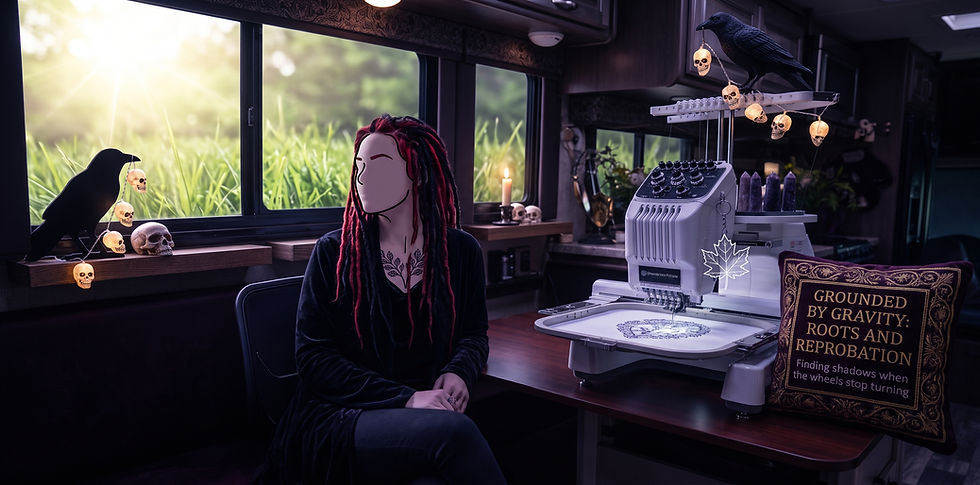
WhichCraft? Studio creates high-end, heirloom-quality embroidery from a very small, very magical studio on wheels. Spooky yet sophisticated. Always made with intention.
Want new posts in your inbox? Sign up using the form at the top of the blog page at whichcraftstudio.com/blog.


Very interesting story. I am not sure what my hoop would stitch but I bet it would be beautiful. I love to stitch, it is my way to put love into what I do.