


The Fates and the Thread: Who Holds the Spindle


Long before anyone thought to call a life a story, they called it a thread.
In the oldest tellings, the thread was not a metaphor. It was an object, and someone was holding it. Someone was spinning it out of raw fleece, measuring it against a rod, and deciding how far it would be allowed to run.
I think about this every time I load a spool.
Three Women at the Wheel
The Greeks called them the Moirai, and they were not gentle. Clotho spun the thread of each new life. Lachesis measured it, deciding how much each person would be given. Atropos, the one who cannot be turned aside, waited with her shears.
Even the gods were said to answer to them. That is a remarkable thing to say about three women doing what was, at the time, ordinary household work.
The Norse had their own version. The Norns sat beside a well at the foot of the world tree, weaving the fates of gods and mortals alike. The Romans had the Parcae. Different names, different shores, the same unsettling image: fate as textile, and women at the loom.
I find it telling that every culture reached for the same craft when it needed to explain the unexplainable. Thread was the one thing everyone understood. It was precious, it was patient, and it could not be rushed.
Dangerous Needlework
Once you start looking, the old stories are full of perilous spinning and sewing.
A spindle ends a princess's childhood with a single prick of the finger. A miller's daughter is locked in a room of straw, and the price of her survival is gold spun from nothing. Arachne weaves so perfectly that a goddess grows jealous, and she spends eternity as a spider, still weaving.
Philomela, silenced by cruelty, stitches the truth into cloth and sends it to her sister. Her needle speaks when she cannot.
And then there is Penelope, my favorite. By day she wove a burial shroud. By night she quietly unpicked it. For years, she held an entire kingdom of suitors at bay with nothing but thread and patience.
These are not stories about sewing. They are stories about power. About who is permitted to have it, and what a person will do with the only tools she has been handed.
What the Hoop Remembers
When I sit with a design, I feel a little of that old weight.
A stitch, once made, cannot be taken back without a trace. Pull it out, and the needle holes remain. The fabric remembers, even when the thread does not. Every choice is permanent in a small, quiet way, and every choice shapes the ones that follow.
Then there is the back of the work. The front shows what was intended, the clean and deliberate image. The back shows what actually happened: the knots, the jumps, the places where the thread doubled back. The Fates, I suspect, see the back.
I do not say this to be grim. I find it oddly comforting. A life, like a piece of embroidery, is not judged by the absence of tangles. It is the whole pattern that matters, and you can only see the whole pattern from a little distance.
Holding Your Own Spool
Whether or not you believe in the Moirai, there is something worth borrowing from them. They did not simply endure the thread. They worked it. Spinning, measuring, deciding.
So this week, I would invite you to hold your own spool for a moment. What are you spinning right now? What are you measuring, and what are you letting run too long? Where have you been waiting for someone else to pick up the shears?
You may not control the length of the thread. But the stitches in between belong to you.
A Small Charm for the Season Ahead
Something is stirring on the hoop, and the studio would like you ready when it wakes. Until then, take 60% off any one digital design with the code SPINDLE60 at checkout. I will not say what the occasion is. Call it a precaution.
Stay Spooky,
Mercy
Made with Love and Magic.
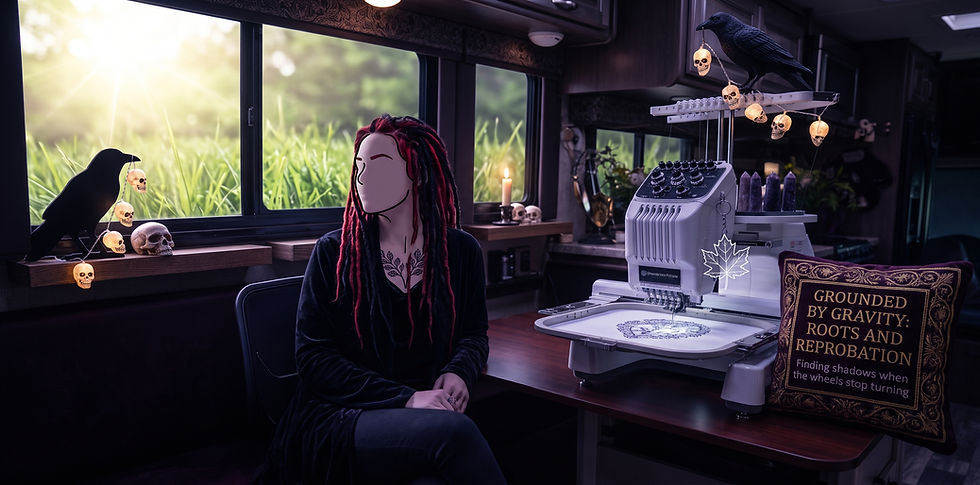
WhichCraft? Studio creates high-end, heirloom-quality embroidery from a very small, very magical studio on wheels. Spooky yet sophisticated. Always made with intention.
Never miss a post. A sign-up form waits at the top of the blog page. Add your email at whichcraftstudio.com/blog and the journal will find you the moment each new post goes live.


Comments